University of Iowa Ophthalmology Researchers Receive Blind Children’s Center Grant to Advance AI-Driven Nystagmus Diagnosis

The University of Iowa Department of Ophthalmology and Visual Sciences has been awarded a $25,000 Lisa D. Hansen Medical Research Grant from the Blind Children’s Center (Los Angeles, CA) to support a new project aimed at improving the diagnosis and prognosis of nystagmus in children.

The funded study, titled “AI-Assisted Eye-Movement Analysis to Improve Diagnosis and Prognosis of Nystagmus in Children,” is led by Alina Dumitrescu, MD, and Randy Kardon, MD, PhD, with co-investigator Mona Garvin, PhD.

In announcing the award, the Blind Children’s Center noted the project’s “potential to have a wide-reaching impact on diagnosing nystagmus,” underscoring its significance for improving care for children with visual impairment.

Addressing a Common and Complex Pediatric Vision Disorder

Nystagmus—an involuntary, repetitive eye movement—affects approximately 1 in 400 children and is among the most common causes of visual impairment in infancy and early childhood. However, it is not a single disease, but rather a clinical sign associated with a wide range of underlying conditions, including retinal disorders, neurologic abnormalities, albinism, and idiopathic eye movement disorders.

Determining the underlying cause of nystagmus is critical for guiding treatment, genetic counseling, and long-term care. Yet current diagnostic approaches can be costly, time-intensive, and difficult to access—particularly for families in underserved or rural communities.

Harnessing Artificial Intelligence for Earlier, More Equitable Diagnosis

The Iowa research team aims to develop an innovative, AI-based approach to analyzing eye-movement recordings as a practical, non-invasive diagnostic tool.

The project will leverage a unique, prospectively collected dataset of high-resolution eye-movement recordings from 100 pediatric patients with nystagmus, each with an established clinical diagnosis and documented visual outcomes. This dataset enables immediate application of advanced machine learning techniques without the need for additional patient recruitment.

Using these data, the investigators will:

  • Identify and classify patterns in nystagmus eye movements
  • Determine whether AI can accurately distinguish between underlying causes
  • Evaluate whether eye-movement features can predict long-term visual outcomes

The central goal is to determine whether AI-driven analysis can provide meaningful diagnostic and prognostic information—potentially enabling earlier and more accessible evaluation without reliance on expensive, specialized testing.

If successful, the approach could eventually be adapted for use with widely available technologies such as smartphone video, expanding access to expert-level assessment in community and primary care settings.

A Strong Interdisciplinary Team

The project brings together clinical and engineering expertise across the University of Iowa:

  • Alina Dumitrescu, MD – Pediatric ophthalmologist and author of the American Academy of Ophthalmology’s Clinical Guidelines for Childhood Nystagmus Workup
  • Randy Kardon, MD, PhD – Neuro-ophthalmologist, Pomerantz Family Endowed Chair in Ophthalmology, and Director of the Iowa City VA Center for the Prevention and Treatment of Visual Loss
  • Mona Garvin, PhD – Professor of Electrical and Computer Engineering and a nationally recognized expert in AI-based ophthalmic imaging at Iowa’s Institute for Biomedical Engineering.

They are supported by a multidisciplinary research team, including Tara Bragg in orthoptics and research engineers, Zhi Chen and Jui-Kai (Ray) Wang, with extensive experience in AI-driven ophthalmic analysis.

Advancing the Mission to Improve Children’s Vision

This work aligns closely with the Blind Children’s Center’s long-standing mission to support research benefiting children with visual impairment from birth through early childhood.

By combining a rare, fully characterized dataset with state-of-the-art artificial intelligence methods, the project is positioned to generate foundational data for larger-scale studies and future NIH/NEI funding. Ultimately, the investigators aim to create tools that improve diagnostic accuracy, reduce delays in care, and expand access to vision-saving interventions for children worldwide.

This work is made possible in part with funding from The Blind Children’s Center, Los Angeles, CA.

Iowa Carver College of Medicine

Sleigh bells ring at Blind Children’s Center

Santa Claus brought smiles to the faces of students at the Blind Children’s Center. (photo by Edwin Folven)

Santa Claus made an annual stop at the Blind Children’s Center on Dec. 18, spreading cheer and fulfilling holiday wishes for dozens of children and families. In a tradition dating to 1970, he arrived on a sleigh accompanied by officers from the Los Angeles Police Department’s Rampart Division, much to the delight of the young students.

Blind Children’s Center CEO Sarah E. Orth said the children were brimming with excitement for weeks in anticipation of the festive event. The families erupted in cheers as a police car with lights flashing towed the sleigh into the center’s parking lot, and Santa climbed down to greet the children.

“I think ritual and history are so important, and this has been going on for 40-plus years. It’s something that we talk about for weeks before Santa comes and we prepare the children for what’s going to happen,” Orth said. “At a time like this in our communities, I think having an event like this where the LAPD is here with families and showing goodwill and being part of the community in this kind of way is really important. It’s a really important message to families, especially recently, who are sometimes feeling really scared.”

Retired LAPD Officer Jack Rose, who dressed as Santa Claus for the event for more than 30 years, joined the families and BCC staff. Rose explained that his involvement started in 1970 when he volunteered to help his partner at the Rampart Division at the time, Officer Sergio A. Robleto, whose niece attended the Blind Children’s Center. The officers dropped gifts off, but Rose said he was surprised to see there was no Santa Claus. He volunteered to don the red suit the next year, starting a tradition that continues today. Rose stressed that it is especially meaningful for children with vision impairment to be able to touch Santa and feel his beard and red suit. Even after he transferred to other assignments, Rose appeared as Santa at the event every year until he retired in 2005.

“You start something out of your heart and you want it to keep going. And when you retire, you wonder if it is going to keep going, if the kids are going to be remembered,” Rose said. “I look at it right now and I realize how lucky we are. How lucky we are that we can help these kids.”

Rampart Division Detective Marc Rojas, who helped organize the holiday event, said officers look forward to meeting the families and children. The visit with Santa was held for the second consecutive year after returning from a hiatus due to the pandemic and building renovations at the center. Officers delivered gifts to the children as families took photographs with Santa. Rojas said the event fosters goodwill in the community.

“It’s become a tradition,” he added. “It’s a good way for us to just let the community know that we are here, shoulder to shoulder with them, not just as an enforcement tool, but as a community asset to help them and assist them.”

Founded in 1938 and located at 4120 Marathon St. in East Hollywood, the nonprofit Blind Children’s Center provides early childhood education programs for children ages 18 months to 5 years old, as well as Early Head Start services for infants and toddlers from birth through 36 months. The center has specific expertise in supporting very young children who are blind and visually impaired, and those with multiple disabilities. For information, visit blindchildrenscenter.org.

Beverly Press & Park Labrea News

ABC7 Eyewitness News at 4:30am – December 18, 2025

The Los Angeles Police Department Rampart Division partnered with the Blind Children’s Center for the Annual Visit from Santa and Toy Giveaway. Watch the ABC7 Eyewitness News at 4:30 a.m. clip here.

Watch NBC Los Angeles News: Thursday, Dec. 18, 2025

The Los Angeles Police Department Rampart Division partnered with the Blind Children’s Center for the Annual Visit from Santa and Toy Giveaway. Watch the NBC4 News at 6 p.m. clip here.

Light boxes, braille writers and smell: How this child care center serves visually impaired kids

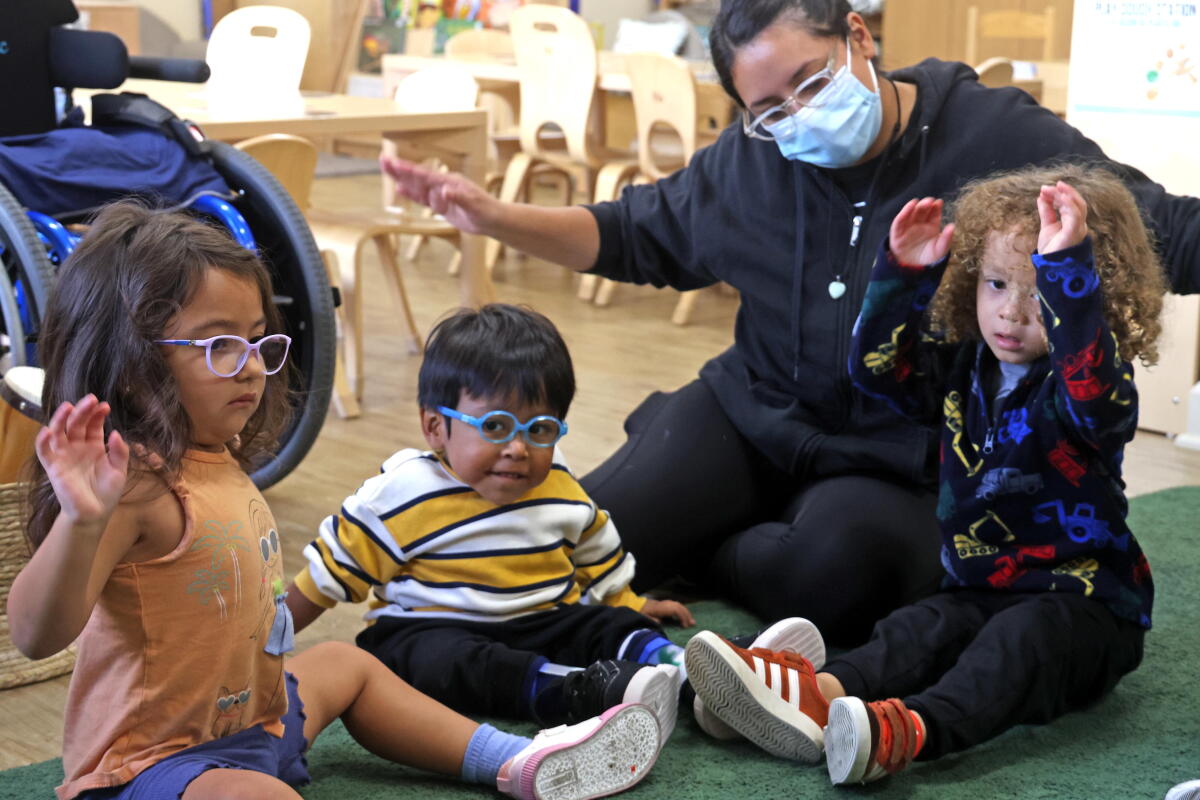
Three preschoolers, two of whom wear glasses, sit on the rug next to their teacher lifting their hands into the air.
Teacher Jennifer Martinez works with Head Start students Arya, left, Baruc and Noah at the Blind Children’s Center in East Los Angeles.(Genaro Molina/Los Angeles Times)

In Saul Valdivia’s preschool classroom, a neon green light emanates from underneath the opaque surface of a wooden table. An assortment of plastic bugs and wooden shapes lay scattered across its surface. This light box learning tool uses contrasts to help encourage young kids with impaired vision develop awareness of objects, light and color.

A braille writer and magnifying device across the classroom are ready to be used. And the lights in the room are sometimes turned off or dimmed to accommodate some students’ light sensitivity.

The specialized classrooms at the Blind Children’s Center in East Hollywood play an outsized role in Los Angeles County, serving as a regional source of child care and early education for infants, toddlers and preschoolers with visual impairments.

More than 11,000 children under age 11 in the county are visually impaired and the center is equipped to address their needs — lessons incorporate smell and touch and include real objects like apples and pumpkins rather than plastic toys. Children with low vision participate in pre-braille learning exercises.

Educational support for youngsters with visual impairments, which are largely under-diagnosed among children under age 5, requires highly individualized learning plans to avoid potential development delays. As a school with Head Start and Early Head Start, the center can serve any L.A. County child with a visual impairment regardless of income.

“We’re in an area that’s lacking,” Chief Executive Officer Sarah Orth said. “And we have those experts on our staff that can support the children and support the curriculum.”

A preschooler sits next to her teacher as she listens to him read a book.
Camila listens as teacher Saul Valdivia reads to students during a Head Start class at the Blind Children’s Center in East Los Angeles. (Genaro Molina/Los Angeles Times)

The center, which was founded in 1938, braids together federal Head Start funds with state preschool and private donations to run its programs. It limits class sizes and provides access to on-site health and disability services to offer a combination of early intervention, early learning and family support. A tenth of the students enrolled in its programs have a visual impairment.

Adapting early learning

Often families don’t know the full extent of their child’s impairment when they first arrive at the Blind Children’s Center, Orth said. Vision screenings help identity their needs.

A child may be legally blind or have low vision, but their conditions vary. Some may struggle to see color, others might struggle with light perception, said Rosalinda Mendiola, an adaptive services specialist.

When Meredith Sun’s son Oscar attended the center several years ago, he learned to navigate his classroom by touch. He would find his cubby based on its proximity to the mat laid out on the floor, and he knew where to sit during circle time because he could feel a mark on the rug.

“They wouldn’t move the chairs around without telling Oscar,” she said, recalling her son’s time at the center. “They would have Oscar feel the classroom where they’re going, and they’d have mats or just different textures on the floor.”

Mendiola helps teachers and staff customize curriculum. Sometimes a child might benefit from sitting near the teacher, having lighting adjusted or fonts enlarged or changed to a different color. They also may need assistance in orientation, mobility and navigating spaces.

Children who will learn braille start preparing with pre-braille. They may learn to track lines and identify shapes, become familiar with touching braille in books and work on finger strengthening with Play-Doh or by pushing keys on a braille writer.

Parents are also taught how to help their child, Mendiola said. She instructs families to narrate their actions, such as by sharing with their child when they slow down at a stoplight on the way back from school.

Building an inclusionary support system

“Bravo,” cheers a physical therapist as she stands next to preschooler named Baruc who sits in a wheelchair during outdoor free play. The child tosses a soccer ball at three plastic bowling pins gathered in front of him, knocking down two. Another child eagerly chases the ball and returns it to him for another try, pointing to his remaining target.

“Everything’s done together — that’s part of the inclusion process,” Orth said. “Everyone’s doing it at their level, whatever it is. It’s everyone together in their own way.”

A child plays with a red toy car on the rug during free play.Student Baruc participates in a Head Start class at the Blind Children’s Center in East Los Angeles.  (Genaro Molina/Los Angeles Times)

The center’s inclusive approach keeps students learning alongside typically developing children, integrating services such as physical and occupational therapy into the children’s regular activities and playtime.

Approximately 40% of enrolled students have a disability, Orth said, compounding the need for specialized support.

“It’s very hard for families to find preschool programs that can accommodate all of the various challenges that they might have,” she said. “Oftentimes kids that have more complex disabilities — they are very isolated. So we’re really wanting to build that community.”

Staff also provide mental health counseling to families and visit students in the hospital when they undergo surgery. And the center hosts education classes and support groups for parents to help them navigate the influx of information and overcome some of the cultural stigma associated with vision loss by encouraging acceptance.

For Meredith Sun, having classes with both visually impaired and non-visually impaired students on such a small scale at the center helped prepare her son Oscar for public school, where his second-grade class has 21 students and he is the only child who is blind.

“His character just developed,” Sun said about Oscar’s time at the center several years ago. “He’s not shy anymore. He looks forward to playing with other kids and playing with the teachers, having silly jokes, sharing his stories at home and with the teacher.”

Part of learning is also getting children to understand how to navigate their environment, Mendiola said. Take the outdoor play area. There, grass meets rubber playground flooring meets concrete. Wooden benches and trees accent the terrain alongside giant Legos and mini soccer goals.

Not only do these objects diversify the play area, but they provide obstacles for some of the kids to navigate. It’s a chance for them to learn how to adapt to surroundings that emulate the challenges of the world outside the center.

If they bump into something, that’s OK, said Mendiola, who is visually impaired. It’s part of the learning experience.

This article is part of The Times’ early childhood education initiative, focusing on the learning and development of California children from birth to age 5. For more information about the initiative and its philanthropic funders, go to latimes.com/earlyed.

Los Angeles Times

Kate Sequeira

How Local Flexibility in Head Start Drives Community – Based Decisions

There is no singular look to Head Start – its federal-to-local structure has served communities and families well over the past six decades, benefiting from the ability to adapt and connect to the unique priorities of individual communities. National standards ensure a baseline of quality. In addition, Head Start programs demonstrate a rich breadth and depth of services across locations — reflecting the spirit, priorities, and cultures of local communities and the parents who help lead each program. The following examples, a small selection from a broader national compendium, illustrate some of the myriad ways that Head Start is adaptable, flexible, and provides communities with the ability to best meet the needs and preferences of local families and children.

Head Start programs create engaging environments to encourage children’s natural curiosity and exploration and foster a love of learning. Through quality teacher-child interactions, strong developmental standards, and locally chosen curricula, Head Start ensures all children are ready for kindergarten.

Since its inception in 2012, the highly popular Mandarin program at Albina Head Start in Oregon has expanded from three classrooms to 17. Daily Mandarin instruction incorporates methods like singing, dancing, movement, art activities, and games. This approach allows children to learn another language while having fun.

In Ohio, the Aullwood Audubon Center and Farm partners with the Miami Valley Child Development Centers to operate a Head Start classroom on a working farm. The program meets all Head Start standards and follows the High Scope curriculum. The children also spend extensive time outdoors on the farm every day, even doing farm chores.

Head Start ensures that geography or unique circumstances are not obstacles to getting a strong start in life. Whether located at the bottom of the Grand Canyon for remote families or on military installations for active service families, Head Start is there.

The Rural Alaska Community Action Program provides home-based Early Head Start services to meet the needs of eight remote Alaska Native communities that engage in subsistence activities, including moving to itinerant fish camps during the summer months.

The Fort Carson Head Start Center, located on the Fort Carson (Colorado) army base, serves more than 100 children, more than 80% of whom have a parent serving in the military. The program is especially equipped to address separation issues that come with parental deployment.

Head Start addresses critical health and nutrition needs so that children are fully ready to learn and grow. It ensures children who otherwise may be experiencing food insecurity are provided with nutritious meals and snacks, often including months when the program is closed. And Head Start brings health services where they are needed most – directly to children while at school or to them and their families through mobile health units and local community health and dental clinics.

Through on-site food pantries with local fresh vegetables and dairy, gardens in the outdoor space, hydroponic plant towers, and a from-scratch kitchen, Colorado’s Clayton Early Learning provides children and parents with nutritious food options for their families.

The Anoka/Washington County Head Start in Minnesota partners with two local dental clinics to provide on-site dental services for their children and families. This has made it possible to avoid long waiting lists and get necessary dental care much sooner than would be the case in the community at large.

Head Start meets children’s early intervention needs more readily than most other community options.

Recognizing the gap in services for children with low vision and blindness, the Los Angeles Office of Education and the Blind Children’s Center created Early Head Start mainstream classrooms that specialize in supporting children with visual impairments. They also help parents and caregivers learn the specialized skills needed to support their vision-impaired child’s growth.

In 2020, Indiana’s Community Schools Head Start took a creative approach to addressing their children’s anxiety and mental health challenges caused by the pandemic: a therapy dog. Westin, the therapy dog, helps children regulate their emotions, cope with separation anxiety from their parents, practice patience, and much more.

Head Start provides a two-generation approach to lift families out of poverty, recognizing that empowering parents helps strengthen families. Through Head Start, parents and caregivers are supported in their efforts to enroll in work and adult education programs, connect to community resources, and engage in parenting activities that emphasize their role as their children’s first teacher.

At the Genesis Center in Rhode Island, parents and children learn together. Through the Children’s Friend Early Head Start-Child Care Partnership, parents attend adult education classes while children participate in Head Start. Parents are supported on their path to financial security through adult education classes, career support, bus vouchers, tax assistance, and a special savings-match program through the Bank of Newport.

The Economic Security Corporation Head Start in Missouri works with a local bank to build parents’ financial literacy and credit scores. Parents and caregivers learn about savings and checking accounts, how to build credit, and other vital financial skills.

Strong community partnerships help stretch limited federal dollars. For example, Head Start expands parent choice with local partnerships that extend care for parents who are working or in school, or have transportation needs.

San Diego’s Metropolitan Area Advisory Committee Child Development Program maximizes Head Start and state funding to provide both center-based and home-based options for families. Family child care homes may utilize and adjust or renovate existing space in a home to provide programming that meets Head Start quality standards.

Parents and Children Together Head Start in Honolulu’s Kahauiki Village is located in an affordable housing community for families who were formerly homeless. Built through a private/public partnership in response to Hawaii’s growing unhoused population, Kahauiki Village offers Head Start services augmented with additional early childhood funds to run 10 hours a day throughout the year, enabling parents to work or complete their education.

National Head Start Association

Low Vision and Blindness 101

One thing we know for sure as parents, every child experiences the world in their own unique way. For our children with vision challenges — whether it’s low vision, blindness, legal blindness, partial sight, DeafBlindness, or even just needing glasses — learning and daily life may require extra support. Since vision needs exist on a spectrum, each child will face different challenges and adjustments. How they adapt depends on how much they can see, any other conditions they have, and the supports they receive. Some might also have additional disabilities, such as developmental delays, sensory differences, or motor challenges, which can add to the complexity. But with the right tools — including an IEP, assistive technology (AT), or specialized instruction — our children can develop the skills they need to learn, explore, and gain independence in a way that works best for them.

To get answers to our most pressing questions about vision-related disabilities, we reached out to experts, including Bianca Ciebrant, program director at Blind Children’s Center; Rosalinda Mendiola, adaptive services specialist at Blind Children’s Center; Mary Peitso, non-attorney special education advocate and founder of Mary Peitso Education Consultant Services; Sonja Biggs, PhD, teacher of the visually impaired (TVI) and co-founder and president at Sonja Biggs Educational Services; and Lisa Concoff Kronbeck, public benefits specialist at Undivided.

Understanding different levels of vision

Not all vision loss looks the same; some children can read large print but struggle with details, while others rely more on touch and sound to navigate the world. Even blindness isn’t always total darkness. Mendiola explains that legally blind individuals often still perceive some light, shapes, or movement. Knowing where a child’s vision falls on this spectrum helps families and educators choose the best tools and strategies to support their learning and independence.

Low vision

A condition involving lasting and significant reduction in sight, low vision affects a person’s ability to see clearly, broadly, or both. It may involve difficulty focusing on small details (reduced visual acuity), a limited field of view (how much you can see around you), or a combination of the two. This type of vision loss typically cannot be fixed with regular glasses, contact lenses, surgery, or medication.

While some vision is often still present, it might not be sufficient for everyday tasks such as reading, identifying faces, or moving safely through new environments. With proper support — including assistive devices, specialized training, and adaptive techniques — many individuals with low vision are able to adapt and maintain independence in daily life.

Blind and legally blind

Legally blind doesn’t always mean no vision at all. Mendiola describes how people often assume blindness means complete darkness, but legally blind individuals can still see to some extent. This classification covers vision from 20/70 to 20/200, which means some kids might still be able to read large print or make out shapes, though finer details might be hard to see.

As vision worsens, it moves closer to blindness, particularly once it reaches 20/400 or beyond. Some children with low vision can still navigate independently, while others rely on high-contrast materials, magnification, or assistive technology to maximize their remaining sight.

Blindness, as Mendiola tells us, rarely means total darkness; most children still perceive some light or movement. While they might not see details, many can still detect brightness, large objects, or motion.

The main difference between low vision and blindness is how much usable sight a child has. Those with low vision might still rely on their sight for certain tasks, while children who are blind often depend on touch, sound, and adaptive tools to navigate their surroundings.

Regardless of where a child falls on the spectrum, the right support and resources can help them access their world and thrive.

Do children born with low vision have different needs than those who lose their vision?

When it comes to tools and adaptive equipment, there’s not much difference between children who are born with low vision or blindness and those who lose their vision later on. Ciebrant explains that “the actual equipment itself is going to be the same equipment that a person or child who’s born with low vision or blindness is going to use.” Whether a child has had low vision since birth or experienced vision loss later, they’ll likely use the same types of technology and resources to navigate the world. But the emotional and social side of things? That’s where the experiences can really diverge. Ciebrant points out that children who are born with low vision or blindness naturally adapt to their world from the start; it’s all they’ve ever known. Using adaptive tools is just part of everyday life, much like learning to hold a crayon or a pencil. “That equipment is just what you’re introduced to from the get-go, from the start,” Ciebrant explains.

For kids who lose their vision later, though, the adjustment can be much tougher. Ciebrant describes it as a major loss, explaining that “vision is probably one of the five senses that we have that really helps us in our day to day.” When a child has relied on vision for any length of time, whether it’s a year or decades, losing it can be a big emotional hurdle. That emotional impact can make it harder to embrace new tools and strategies right away. While the equipment itself doesn’t change, the child’s ability to adjust and feel comfortable using it depends a lot on where they are emotionally.

Ciebrant shares insights on how the needs of children born with low vision compare to those who experience vision loss later in life.

What are the signs of low vision in babies and young children?

Spotting low vision in little ones isn’t always easy, especially since they don’t always show signs in ways we expect. Mendiola explains some key things to watch for:

  • Children with vision issues might either ignore their surroundings or focus on different things than expected, often staring at lights instead of engaging with objects or people.
  • Young children might have trouble reaching for objects. A baby might reach for something right in front of them but either miss, overreach, or underreach — even when grabbing for something familiar, such as a bottle.
  • Caregivers also often notice a lack of eye contact. Mendiola shares, “A lot of caregivers will say, ‘Well, they won’t look at me.’”
  • In some cases, unusual eye movements can also be a sign. As Mendiola explains, “Some signs are that their eye gaze is erratic — you know, their eye movements, they have nystagmus, which is a rapid movement of the eye.” Many parents notice this early on, which can be an important clue that something might be affecting their child’s vision.

What if there are no obvious signs?

Mendiola points out that in some cases, there might not be any clear signs at all. But just because there aren’t obvious red flags doesn’t mean everything is fine. That’s why regular checkups, as Ciebrant explains, can help catch vision issues early. This is one reason why keeping up with scheduled checkups is so important.

If nothing stands out in infancy, mobility milestones might offer a clue. Ciebrant notes that some kids don’t get diagnosed until they start moving around more. A baby who is hesitant to crawl or walk might not just be taking their time — it could be that they’re struggling to see what’s ahead. If they’re more cautious in their movement and not reaching these milestones within the typical range, it’s worth checking their vision to see whether that’s the reason for the delay.

If your child shows signs of low vision, or if you suspect an issue despite no obvious signs, the next step is getting a proper diagnosis.

How are children diagnosed with low vision?

When it comes to figuring out a child’s vision, the journey usually starts with a visit to a specialist. More often than not, families are referred to an ophthalmologist — the doctor who takes a deep look (literally) into the eyes to figure out what’s going on behind the scenes. As Mendiola explains, “The person who diagnoses the low vision is going to be the ophthalmologist because the other doctor is going to prescribe glasses.” The ophthalmologist examines the structures inside and behind the eye to determine what’s happening with a child’s vision.

Now, when it comes to helping kids see better, an optometrist plays a key role too. They provide low vision aids, including glasses, that can make a big difference in how a child interacts with the world. In some cases, a low vision specialist might also conduct a more detailed low vision examination. But in those early stages, it’s typically the ophthalmologist who gives families their first real insight into their child’s vision and helps guide the next steps.

Early diagnosis helps, but some vision issues aren’t easy to spot — especially when the challenge is in how the brain processes what a child sees. That’s why some kids don’t get diagnosed until much later.

Why are some children diagnosed so late?

Sometimes, spotting a vision issue isn’t as easy as we’d hope. Mendiola explains that some conditions make early diagnosis more difficult, especially when the issue isn’t with the eyes themselves but with how the brain processes visual information, such as in individuals who have cerebral/cortical visual impairment (CVI). Since CVI affects how the brain interprets what the eyes see, it can be tricky for caregivers and doctors to detect early on.

One reason for the delay is that some children with CVI might appear to see normally at first. Their eyes might look healthy, and they might react to certain visual stimuli, making it harder to recognize a problem. Mendiola points out that CVI can be caused by factors such as birth-related asphyxiation, near drownings, or accidents. But because the challenge is in brain processing rather than the eyes themselves, the signs might not be immediately obvious.

For some children, vision difficulties don’t become clear until they start missing developmental milestones or struggling with activities that require strong visual skills. A baby who is hesitant to crawl or walk might not just be taking their time — it could be that they’re struggling to see what’s ahead. Some children aren’t diagnosed until their teenage years or even adulthood. As Mendiola says, “Sometimes they might look like they can see, but unfortunately, the problem is inside the brain. So it’s going to take a while before people start noticing there’s things going on, and it takes a while.” That’s why ongoing checkups and early intervention are so important, even when there aren’t obvious signs of a vision problem.

In some cases, vision issues don’t present alone; other developmental conditions can make diagnosis even trickier. If you do suspect your child has low vision or CVI behaviors, it’s important to see a neuro-opthomaologist who will be better able and qualified to diagnose your child.

When low vision co-occurs with other disabilities

Here’s something to keep in mind: low vision often goes hand in hand with other developmental disabilities, making diagnosis trickier. Ciebrant tells us that a child may have both low vision and additional needs, such as orthopedic or developmental challenges.

Autism

Autism is one of the biggest challenges when it comes to diagnosing low vision. Since some traits of autism — such as differences in communication or sensory processing — overlap with signs of low vision and blindness, it can be tough to tell what’s what. Autism is very common in children who are blind, with some statistics showing that blindness is about three times as common in autistic children as in their typical peers. Other statistics indicate that 13.5 percent of autistic children have vision disorders compared with 3.5 percent of typical children. This can create a real barrier to early identification. “When diagnosing autism in blind children, it is important to recognize that certain behaviors that seem autism-related can be attributed to an inability to see,” according to this article in the neuroscience publication The Transmitter.

Brain injuries and trauma

Brain injuries and trauma can also complicate things. Mendiola points out that conditions such as optic nerve hypoplasia affect the back of the brain, which is close to areas that regulate hormones and growth. Because of this, kids with this condition might also have related health concerns (such as diabetes insipidus or growth hormone deficiencies) that aren’t always diagnosed right away.

Processing issues vs. eye function

It’s important to remember that vision involves more than just the eyes — it also depends on how the brain processes what the eyes see. Ciebrant explains that the eyes work like a camera lens, capturing images, while the brain puts the full picture together. When there’s a processing issue in the brain, it might not show up in a standard eye exam. For children who are nonspeaking or have limited mobility, typical vision tests — such as identifying letters or shapes — can be especially difficult, which can delay a proper diagnosis.

DeafBlindness

DeafBlindness refers to a combination of hearing and vision loss that makes it harder for a person to communicate, get information, and move around safely. The type of vision and hearing loss differs from child to child. It’s also important to understand that DeafBlindness exists on a spectrum — some children may have usable vision or hearing, or both. A common myth is that all DeafBlind children experience total loss, like Helen Keller, but this is rarely the case. But statistics show that 85% of children with DeafBlindness have one or more additional disabilities. As the National Center on DeafBlindness explains, “The limited sensory channels available for learning necessitate developing a highly individualized program for each child that addresses their interests and unique ways of learning.”

Teamwork is even more critical. Dr. Biggs explains that their support team often includes a teacher for the d/Deaf and hard of hearing, an occupational therapist (OT), a speech-language pathologist (SLP), a teacher for the visually impaired (TVI), and an orientation & mobility specialist — sometimes with an interpreter or intervener, who “through the provision of intervener services, provide access to information and communication and facilitate the development of social and emotional well-being for children who are deaf-blind.” Just as important is identifying the student’s preferred communication method, whether that’s American Sign Language (ASL), signed English, or another system, to ensure the student can fully engage with learning.

A team-based approach is essential for students with multiple disabilities. Dr. Biggs stresses that teachers, therapists, and specialists must collaborate to provide well-rounded support. By assessing each student’s needs and bringing together the right professionals, schools can create a learning environment where every child receives the support they deserve. Peitso explains more about what educational supports should be considered for students with co-occurring conditions:

What causes low vision?

Low vision isn’t a single, clear-cut condition — it can be caused by a variety of medical issues that affect how the eyes develop or function. Some conditions are present at birth, while others develop over time due to illness, injury, or genetic factors. Mendiola explains that some kids might have partial vision, while others might perceive only light or shadows. Even blindness itself doesn’t look the same for everyone, as levels of vision loss can differ greatly.

  • Retinopathy of prematurity (ROP): According to Mendiola, some babies who are born prematurely or with very low birth weight develop ROP, a condition that affects how blood vessels form in the retina. Mild cases often improve on their own, but more severe cases can cause vision problems or even blindness if left untreated. That’s why doctors carefully monitor premature infants with regular eye exams — early detection can make a big difference. If needed, treatments like laser therapy or injections can help protect vision. Children who have had ROP may also need glasses or other vision support as they grow.
  • Cataracts: Although cataracts are commonly linked to aging, they can also affect babies and children. A cataract is a cloudy area in the lens of the eye that can make vision blurry or dim. Some children are born with cataracts, while others develop them later due to an injury or illness. When cataracts affect vision, surgery is often an effective treatment.
  • Vitamin A deficiency: Vitamin A is crucial for maintaining healthy vision. A severe deficiency can lead to night blindness and, in extreme cases, permanent vision loss. Though uncommon in the U.S., vitamin A deficiency is a leading cause of preventable blindness in some parts of the world. A balanced diet or supplements can help support eye health.
  • Retinitis pigmentosa (RP): RP is a group of rare genetic conditions that cause gradual vision loss over time, often beginning with difficulty seeing in low light. This happens as cells in the retina slowly stop working. While there’s currently no cure, early diagnosis can help families access tools and resources to prepare for changes in vision.
  • Conjunctivitis (pink eye): This common eye infection can cause redness, irritation, and temporary blurry vision. While usually not serious, frequent or severe infections may make it harder for kids with low vision to use their remaining sight comfortably. Proper hygiene and prompt treatment can help prevent complications.
  • Uncorrected refractive error: Sometimes, vision issues stem from an uncorrected need for glasses. Conditions such as nearsightedness, farsightedness, and astigmatism can affect learning and daily activities if not addressed. Regular eye exams ensure that children get the right prescription, making a big difference in their ability to see clearly.

These conditions affect vision in different ways; some children may have a specific diagnosis, while others experience more general challenges with how clearly or how much they see. Because of this, low vision can look very different from one child to another, ranging from mild sight limitations to legal blindness.

What medical interventions can be considered for low vision?

What medical interventions can actually help? That depends on each child’s unique situation.

Surgery

Mendiola explains, “A lot of the surgeries that can be considered are mainly for the vision, to correct eye turns and glaucoma, to relieve the pressure in the eye to prevent further vision loss.” In everyday terms, these procedures are meant to adjust misaligned eyes and reduce eye pressure so that further vision loss can be prevented. Although these surgeries can improve eye alignment and slow further deterioration, they don’t always restore perfect vision. For instance, nerve surgery might help adjust the turning of the eyes, but it doesn’t necessarily mean the child will end up with 20/20 vision.

Vision therapy

Vision therapy is another option that some families explore. Keep in mind that it’s a medical intervention typically managed by healthcare professionals rather than educators. As the American Academy for Pediatric Ophthalmology and Strabismus (AAPOS) states, vision therapy is an “attempt to develop or improve visual skills and abilities; improve visual comfort, ease, and how well the eyes work; and change visual processing or understanding of visual information. A vision therapy program is usually made up of monitored in-office and at-home eye exercises that are done over weeks to months. In addition to exercises, lenses (‘training glasses’), prisms, filters, patches, electronic targets, or balance boards may be used.”

Mendiola notes, “Teachers of the visually impaired don’t do vision therapy. That’s more of a medical thing that happens with medical doctors.” In other words, while this therapy helps build specific visual skills, it requires the specialized expertise that only medical professionals can provide.

Interestingly, for some young children vision can gradually improve on its own over time. Mendiola shares, “Sometimes children that are younger, like 0–3, gain some vision, but because their vision loss is not necessarily caused because of a medical problem, but because of a maturity problem, some people call it delayed visual maturation.” In other words, as their visual system naturally matures, these little ones might start to see better without the need for immediate medical intervention.

Since every child’s vision needs are different, medical interventions vary. But understanding the specific condition behind a child’s vision loss is just as important; it helps determine the right support, tools, and expectations for the future.

Where to start: getting support for a child with low vision

If your child has low vision, you’re probably juggling a lot of emotions — and questions. The good news? There are systems in place to help. Whether your child is just a baby or already in school, there are services designed to support their development, learning, and access to the world around them. Here’s how it typically works.

For children under age three: early intervention services

The earlier we can identify a child’s vision needs, the better. That’s where early intervention comes in. These services are designed to help babies and toddlers with developmental delays or disabilities — such as low vision or blindness — get what they need as early as possible. In California, this system is often coordinated through your local Special Education Local Plan Area (SELPA).

As Concoff Kronbeck explains, “SELPAs provide early intervention programming for kids with low-incidence disabilities, and in California, that generally includes people with orthopedic impairment, people with vision and hearing impairments, and people with multiple disabilities.” Services that a SELPA could provide to a child with an eligible low-incidence disability include physical, occupational, speech, and behavioral therapy, as well as assistive technology (AT). If your child qualifies, SELPA services offer a strong foundation in these early years.

Both SELPAs and Regional Centers provide Early Start services for children 0–3, which can be somewhat confusing. A child who also has a developmental disability or delay can receive services from both the SELPA and their local Regional Center (more on Regional Centers in the public benefits section). But if your child doesn’t qualify for early star school-based services through SELPA, and has a developmental disability, Regional Center can help.

If your child is under age three with potential or diagnosed vision loss, start by contacting your local SELPA and asking for a comprehensive assessment. Find your SELPA by scrolling down to your county on this CDE page. Once you contact your SELPA, a staff member will coordinate the assessment process and work with you to develop a service plan based on your child’s needs.

Once a child is identified, an Individualized Family Service Plan (IFSP) team evaluates their needs. This plan outlines services such as vision therapy, orientation and mobility instruction, and parent support. Dr. Biggs explains that this team determines what services the child will receive under the IFSP, which differs from an IEP. She notes, “Generally, a SELPA has a birth-to-three program in their special education program.” If a SELPA lacks a dedicated program, it usually partners with outside organizations that provide in-home support through early intervention specialists.

Over age three: special education through the school district

Once a child turns three, responsibility for special education shifts to the LEA — typically the school district. In larger districts, the SELPA and the LEA may be the same, but in smaller areas, multiple school districts often share one SELPA, which provides services across those districts. While SELPAs oversee regional special education planning, the student’s home school district is responsible for implementing special education services through an IEP.

Peitso points out, “You would look to your school district to do an assessment for visual impairment.” If eligible, your child will receive an IEP with services such as a teacher of the visually impaired (TVI), assistive technology, orientation and mobility, or placement in a specialized program if needed.

IEP eligibility for low vision and blindness

Eligibility for an IEP is based on whether a child has one of 13 qualifying diagnoses. Under California Education Code, visual impairment (VI), including blindness, means an impairment in vision that, even with correction, adversely affects a child’s educational performance. The term includes both partial sight and blindness. DeafBlindness (DB) means concomitant hearing and visual impairments, the combination of which causes such severe communication and other developmental and educational needs that they cannot be accommodated in special education programs solely for children with deafness or children with blindness.

Note that the word “impairment” is part of the IDEA’s official language; we at Undivided typically use “low vision, partially sighted, or blind” for visual impairment.

Low vision as a low-incidence disability

Note that “visual impairment” is a low-incidence disability under IDEA. Low incidence essentially means affecting less than 1 percent of the population. According to IDEA, this includes “a visual or hearing impairment, or simultaneous visual and hearing impairments.”

According to California Education Code, low incidence is defined as “a severe disabling condition with an expected incidence rate of less than 1 percent of the total statewide enrollment in kindergarten through grade 12. For purposes of this definition, severe disabling conditions are hearing impairments, vision impairments, and severe orthopedic impairments, or any combination thereof.” To learn more about this, head to our article Low-Incidence Disabilities 101.

Is a 504 plan the right fit for a child with low vision?

Trying to decide between a 504 plan and an IEP? It all comes down to what your child needs, says Dr. Biggs. A 504 plan works well if a child needs only accommodations — such as large-print materials, high-contrast text, or preferential seating — to access learning. Since a 504 plan falls under general education, it ensures equal access but does not provide specialized instruction.

An IEP goes further. If a child needs specialized instruction — such as braille instruction, orientation and mobility (O&M) training, or direct support from a teacher of the visually impaired (TVI) — then an IEP is the right fit. Since school districts fund 504 plans separately from special education, services such as TVI instruction and O&M training are available only through an IEP.

That’s why thorough assessments are so important. As Dr. Biggs explains, “Any child who has low vision needs to be assessed using functional vision, learning, media, Expanded Core Curriculum, orientation, and mobility assessments to determine the need.” These evaluations help determine whether a child can succeed with accommodations alone or whether they require an IEP for additional services.

Dr. Biggs explains why 504 plans might not provide adequate support for children with low vision:

IEP assessments for low vision

Dr. Biggs and Peitso agree that IEP services for students with low vision should address both academic and functional needs. In addition to specialized instruction from a TVI and O&M training, related services might also be necessary. Every IEP for a student with visual impairment must include a discussion about braille instruction. Whether a student uses braille depends on their learning media assessment (LMA) results and individual needs. Some children might also struggle with balance or fine motor tasks. A physical therapist can assist with movement, while an occupational therapist can help with skills like gripping a pencil, cutting with scissors, or buttoning a shirt — promoting independence in a way that works for them.

But before all that happens, they will need a few assessments to help determine which services and supports are needed.

Assessments for low vision and blindness in an IEP

If your child is blind or has low vision, the school is required by California law (Education Code 56352) to figure out the best way for them to access learning materials — like whether they need braille, large print, audio, or something else. This is done through a special evaluation called a learning media assessment (LMA). But before that happens, there’s usually another important evaluation called a functional vision assessment (FVA). This looks at how your child uses their vision in everyday school activities — like reading the board, walking down the hallway, or finding their lunchbox. Here is what that process looks like (find more about this in this pdf of California guidelines for VI).

Functional vision assessment. The functional vision assessment is considered a best practice and a necessary component of evaluating a student with low vision. This is done at school by a TVI to evaluate how your child uses their vision in daily activities. This helps determine how their vision impacts mobility and learning.

Learning media assessment. The LMA is done by a TVI and is used to understand which sensory channels your child uses to learn best — and how learning materials should be presented to support them. According to Dr. Biggs and Peitso, every child with low vision learns differently, and an LMA helps determine what works best, ensuring they receive the right support in school. “The learning media assessment determines the media the student learns in, whether that be braille, large print, audio, tactile graphics, real models, or real life experiences — sometimes the student may need all of those modalities,” Dr. Biggs says. Instead of guessing, this assessment provides clear insights into the most effective learning methods. An LMA helps:

  • Identify learning preferences: determines whether a child is an auditory, tactile, or visual learner.
  • Prevent incorrect assumptions: schools may misjudge a child’s needs without proper data, creating unnecessary obstacles.
  • Strengthen advocacy: a documented assessment makes it easier to request the right materials, AT, and classroom accommodations.
  • Support long-term learning: since vision and learning needs can change, regular LMAs help adjust support as needed.

Orientation & mobility assessment. California Education Code 56354 specifies that if an O&M evaluation is determined to be needed for a child with low vision, it must be conducted by a person who is appropriately certified as an orientation and mobility specialist. O&M is a related service in the IEP. O&M services are determined by an assessment done by an orientation and mobility (O&M) specialist — they look at how your child gets around at school and in the community and make sure your child is moving safely and confidently in their environment. More on O&M later.

Expanded Core Curriculum (ECC) assessment. California Education Code 56353, also recognizes the importance of assessing the ECC for children who are blind or have low vision. It states that local educational agencies (LEAs) may consider the ECC when developing IEPs for students. This assessment is done by a TVI and specifically focuses on the nine areas of the ECC. It should highlight both your child’s strengths and the areas where they might need support. More on ECC later.

AT assessment. This assessment can help identify the tools that will best support your child’s learning. It might be something like a CCTV to enlarge text, a communication device (which would be coordinated with their speech-language therapist), specialized computer programs, or even an adapted keyboard. As Dr. Biggs explains, “The AT assessment can be done by an AT specialist there at the school to determine, for example, if the student needs a special stand for a wheelchair. But a TVI needs to be working with that AT specialist, if it’s not the TVI doing the AT assessment themselves. TVIs are trained to do that.” More on AT later.

Does a child have to be blind to receive VI services?

Here’s something reassuring: vision loss exists on a spectrum, and a child does not need to be completely blind to qualify for services. As Dr. Biggs explains, “So blindness is a spectrum — just like autism is a spectrum, deafness is a spectrum, blindness is a spectrum — so not everybody who’s blind is totally blind, and so no, you don’t have to be totally blind to get services. Services are determined by whether or not the student has trouble accessing the curriculum or their daily life, doing daily life skills due to vision. And it doesn’t have to be someone who’s totally blind. It just has to be that their vision is affecting their performance in some way.”

Peitso adds that if children have low vision, which is not necessarily blindness, they can still receive services and supports. The key factor is whether a child’s vision affects their ability to keep up with schoolwork or daily tasks. If their eyesight makes learning or independence more challenging, they may qualify for VI services.

What about students who need glasses but don’t qualify as having low vision or blindness?

When it comes to students who need glasses but don’t meet the criteria for a low vision diagnosis, the educational approach shifts a bit. Instead of specialized vision services, educators and families concentrate on making sure that the child can participate fully in the educational environment.

Ciebrant explains, “If they don’t qualify for a low vision diagnosis, they probably are not going to have an IEP or IFSP. If they’re wearing glasses because of astigmatism or because they are nearsighted or farsighted . . . but they don’t fall under the legally blind category or a low vision category because there’s not a diagnosis beyond an astigmatism or nearsightedness, they’re probably not going to get an IEP because the IEP is really to access the curriculum.” In other words, when glasses correct a child’s vision into an acceptable range, additional vision-specific supports through an IEP usually aren’t needed.

For children whose vision is improved with glasses, the focus in the classroom shifts to how they interact with the curriculum rather than on receiving special visual support. If a child has additional conditions — such as CVI, where vision fluctuates throughout the day — a comprehensive assessment might be needed to adjust classroom settings, like optimizing lighting and seating arrangements, to better suit their needs. Additionally, Ciebrant points out that if a student has only one functional eye with sufficient vision (for example, 20/20 or 20/40), they most likely will not receive an IEP because their overall visual capacity, including peripheral vision, is considered adequate. In such cases, services might be provided only for very specific needs, such as orientation and mobility training when learning to cross the street.

A big part of the puzzle, however, is ensuring that young children wear their glasses consistently. Many kids, as Ciebrant explains, see glasses as a strange object on their face, and helping them get comfortable with this new accessory can be the first hurdle. Families and educators help children get comfortable with wearing glasses every day to ensure they can access classroom materials.

Placement and inclusion for children with low vision

For kids with vision challenges, inclusion is about more than just being in the same classroom as their peers; it’s about making sure they can actively participate in every part of school life. As Dr. Biggs explains, “A student who has low vision should be included in just about everything, with accommodations, socially as well as academically, and should even be involved in after-school sports and dances.”

Inclusion really works when changes are made to help students learn in the same way as their peers. This could mean accommodations like enlarging text, providing audiobooks, or using braille materials. Dr. Biggs recalls a teacher who really made inclusion a priority: “I had one teacher who was phenomenal. His VI student needed an 18-point font, so he made all of his materials in 18-point font for all of his students. And the student was included, and he wasn’t singled out. So that teacher was amazing, and that student never felt like he was special or that he was different, because all the materials were the same for everyone.”

Students who have DeafBlindness also benefit from inclusive environments, though their supports might look different. Some districts offer specialized classes, while others provide itinerant teachers, sign language interpreters, or optimized classroom acoustics through SELPA programs. Students with DeafBlindness should have full access to discussions, captions on videos, and seating adjustments to improve communication. Dr. Biggs says that in addition, they often require a multidisciplinary team that may include a teacher of the d/Deaf and hard of hearing, a TVI, an O&M specialist, an OT, an SLP, and potentially both an interpreter and an intervener. These professionals must collaborate to ensure that the student’s communication needs — whether they use ASL, signed English, or another method — are fully supported.

If you have concerns, check out our article What to Do When “Inclusion” Isn’t Working for more information and helpful resources.

Do blind students need to attend a school for the blind?

When it comes to placement and specialized classrooms and schools, there are many options for children. There are classes for blind children and those with visual impairment. Districts may have classes specific to these populations. If they do not offer the programs within their district, they might look to the neighboring district, a SELPA program, or a county placement. They also might hire an itinerant teacher to provide curricular support and/or related services. Such programs specialize in what students who are blind or have low vision require to access their education, such as sign language, room acoustics, braille, etc.

However, according to Peitso, a specialized school isn’t required for all students. “They don’t necessarily need to go to a school for the blind, but they do need accommodations.” Many students thrive in their home districts with the right supports in place.

Dr. Biggs agrees, adding, “Students do not have to go to a school for the blind, so they can be served just fine in their home districts, and if their district is providing for all of their needs, then they can stay there.”

Similarly, Ciebrant emphasizes that the right school environment depends on each child’s unique needs. Some children, including those who are completely blind, thrive in general education classrooms when they have the right supports, such as magnification devices or braille and large print materials. But some parents might feel that a general education classroom is more restrictive when compared to a more specialized environment (such as classrooms for the blind) where everyone shares their communication mode. What’s most important is ensuring that the school provides the academic and emotional support a child needs and that parents advocate for the right resources to set them up for success.

However, social experiences matter too. If your child feels isolated or struggles with bullying, Dr. Biggs points out that it “might be a good idea to see about going to a school for the blind where they can experience acceptance and being the same as other kids.”

Mendiola reflects on this challenge from her own experience: “When I was a child — and my parents’ story is not representative of what every parent’s story should be — my parents didn’t want me to go to a school for the blind because I could see. I don’t know if that was a service or a disservice that they didn’t want me to go to a school for the blind, but I struggled. I struggled a lot being in a typical school because of my looks. I was different-looking and I couldn’t see the board and I got teased and I was made fun of, and it was very difficult. So do I think I should have gone to school for the blind? Maybe. I don’t know.”

In the end, what matters most is finding the right fit — both academically and socially — so that each student has the best opportunity to learn and connect with their peers.

The Expanded Core Curriculum (ECC)

For students with low vision, learning goes beyond math and reading — it’s also about building essential everyday skills. That’s where the Expanded Core Curriculum comes in. As Dr. Biggs puts it, these are “skills that a student with visual impairment needs to learn to be successful, over and above the core academic curriculum.”

The ECC is comprised of nine key areas designed to promote growth, life skills, and accessible learning, including compensatory strategies (such as braille), orientation and mobility, assistive technology, self-determination, career education, recreation and leisure, independent living, social interaction, and sensory efficiency.

As Dr. Biggs explains, “The Expanded Core Curriculum for visually impaired students is the curriculum that is needed for students to learn to be able to function successfully at school, at home, and in the community. So it takes in the whole child, from after-school sports to in the classroom to how they’re successful at home doing their laundry. We have to assess the student using an ECC assessment, and the ECC fills in the gaps that a student with a visual impairment experiences that a typically developing student would learn by looking.”

Why the Expanded Core Curriculum matters for kids with low vision:

  • Everyday context isn’t always obvious: a child who is blind might not realize that sliced apples from the fridge originally came from a tree or were bought at a store — because they’re missing the visual clues most of us take for granted.
  • They need to be taught differently: since so much of the world is learned visually, children with vision loss need explicit instruction in certain skills that sighted kids often pick up naturally.
  • That’s where the EEC comes in: the ECC is a set of skills specifically designed for students who have low vision or are blind. It goes beyond reading, writing, and math to include things like daily living skills, orientation and mobility, social interaction, and technology use.
  • It’s taught by trained specialists: these skills are taught by TVIs and O&M specialists — professionals who are specially trained and certified to meet the unique learning needs of students with vision loss.

Here’s how to advocate for EEC instruction:

  • Start with a team meeting: ask to meet with your child’s IEP team and request an assessment specifically focused on the nine areas of the ECC.
  • Make it official: this assessment should be documented and should highlight both your child’s strengths and the areas where they might need support.
  • Use the results to build goals: once the assessment is done, work with the team to update your child’s IEP with new goals based on those findings — so your child gets targeted instruction in the areas that matter most.

Orientation and mobility (O&M)

When your child has a vision impairment, everyday tasks such as moving through a classroom, crossing a street, or finding the bathroom at school aren’t automatic — they need to be taught step by step. This is where orientation and mobility (O&M) instruction comes in. Orientation and mobility helps students with low vision build the skills they need to navigate the world safely and independently. More than just moving from place to place, this training fosters confidence by developing essential skills, including spatial awareness, safety measures, environmental cues, use of mobility aids, cane travel, techniques for various types of travel, street crossings, navigation, navigating transportation, route planning, following directional language, and becoming oriented to an environment.

Ciebrant explains that an O&M specialist helps children make sense of their surroundings in ways that sighted individuals might naturally pick up. For example, concepts like ceilings or the difference between indoor and outdoor spaces aren’t always obvious to a child who is blind. O&M training introduces them to different textures, surfaces, and sounds, helping them move more independently. Whether it’s crawling toward a favorite toy, recognizing changes in flooring, or learning how to cross a street without seeing traffic, O&M specialists equip children with the tools they need to navigate their environment safely and confidently. And because O&M skills are critical for daily life, services are available from birth through age 22.

Ciebrant gives us a breakdown of what her day-to-day duties as an O&M specialist are:

Mendiola shares how her own perspective on O&M changed over time. “So all my life, I wanted to pretend I had 20/20 vision, and for the most part I got away with it, until I would bump into a wall . . . And I thought ‘I don’t need a cane’ until I met [an orientation specialist] who told me, ‘You need a cane. You need to use a cane. You need to fix it.’ So I started doing a lot of traveling . . . and I would get to an airport and I would pull out my cane and I would have 20 people on me asking, ‘Do you need help?’ And I thought, ‘Wait a minute. This cane is magic; I’m going to use this cane.’”

Even in familiar places, changes to the environment — such as remodeling at her workplace — reminded her how crucial O&M skills are throughout life. “Orientation and mobility is a lifelong thing because when I go to the mall, when I go to the airport, when I go to a new restaurant, it’s a game changer to take my cane.” Read more about this in our article Orientation & Mobility (O&M) 101.

Should a child have an O&M goal?

If a student struggles with navigation, an O&M goal should be included in their IEP to ensure they receive structured instruction tailored to their needs. Since O&M is an officially recognized related service in special education, students can receive it as part of their IEP.

However, Ciebrant tells us that not every child with a vision challenge will require O&M services, as it depends on a variety of factors. “Not everyone’s going to use a cane. You have to be able to understand the feedback from the cane, what it means. You have to be safe with the cane. You have to understand that it’s an extension of your body when you’re using a cane.” Some students might receive O&M training even if their vision is currently good but is expected to decline over time. Others may use orientation and mobility strategies without a cane, depending on their diagnosis and level of functional vision. The decision is based on assessments by the student’s vision team to ensure they receive the right level of support at the right time.

IEP goals for low vision

Dr. Biggs explains that IEP goals are based on assessment recommendations and are tailored to each child’s specific needs. They may include specialized instruction for using assistive technology or reading with visual accommodations, such as increased spacing or high-contrast text. Since low vision affects each child differently, IEP goals will vary to reflect their individual learning and access needs. Find more information on IEP goals in our article A Parent’s Guide to IEP Goals.

Here are two sample goals Peitso shares with us. Note that these are just samples. Goals will be different for each child and each situation.

  • While in the classroom, Johnny will develop active listening skills by using speech to text to decipher who, what, when, why and how information from audio sources, including live lectures with 80% accuracy in 4/5 opportunities as measured by work samples by (date).
  • Student will independently demonstrate skills for using a magnifier by holding the magnifier properly, communicating the purpose of the device, cleaning the magnifier appropriately, initiating use of the magnifier, and storing the magnifier in a convenient location with 80% accuracy in 4/5 opportunities by (date).

Classroom accommodations for low vision

Supporting children with low vision goes beyond simply enlarging text. The right accommodations can make learning materials more accessible while reducing eyestrain and frustration.

Peitso emphasizes that audio formats help students with low vision access their curriculum more effectively, whether through audiobooks or recorded lessons. This allows them to absorb information in a way that best suits their learning needs.

For printed materials, size and clarity are key. Large print can help, but Dr. Biggs points out that students might also need adjustments such as bold-lined paper, high-contrast worksheets, or fewer math problems per page to improve readability. She explains, “They need large-print bold letters in a certain font size that is simple with no serifs, and I usually recommend Arial bold.”

Additional accommodations might include:

  • Seating arrangements that maximize visibility
  • Written versions of board notes for students who struggle to see from a distance
  • Tactile models and raised-line drawings for diagrams and visual concepts
  • Accessible tools in science labs, such as talking thermometers and timers with raised markings
  • All materials provided in enlarged font
  • Magnification provided
  • A 1:1 aide during transportation for medical needs
  • Slant boards or a slanted surface
  • Verbal descriptions of visual aids
  • High-contrast materials
  • Color-contrast materials
  • Larger manipulatives
  • Reduced clutter on the page
  • Printed copies of what’s being presented on the board
  • Audio-recorded, braille, or electronically formatted notes, handouts, and texts
  • Braille lab signs and equipment labels, as well as auditory lab warning signals
  • Access to computers with optical character readers, voice output, braille screen display, and printer output

Since every student’s needs are different, functional vision, learning media, and AT assessments help determine the best accommodations. As Dr. Biggs explains, “It depends a lot on the individual student’s needs and what the assessment discovers.”

Common classroom supports for students with low vision

Supporting students in writing, organization, and math

Making small adjustments can significantly help students with low vision as they work through writing, organization, and math tasks. With the right support tools and the ability to speak up for themselves, students can engage more effectively with their learning.

Writing supports

For students who find print hard to read, writing down their thoughts can be tough. But simple changes can really help. Peitso notes that bold-lined paper or text-to-speech software often makes it easier for students to express themselves. Dr. Biggs recommends soft-lead pencils or markers to improve text clarity and notes that some students prefer typing over handwriting.

Ciebrant emphasizes the value of magnification tools, such as video magnifiers, for writing support. These devices capture images via a camera and present them on a screen, allowing students to enlarge their work for better visibility and more effective engagement based on their specific vision requirements.

Organization supports

Keeping materials organized can greatly help students maintain focus, and incorporating bright colors can make a big difference. Peitso recommends using color-coded folders and highlighters to quickly locate essential papers, making organization simpler. Dr. Biggs points out that providing hands-on models or concrete examples can help students better grasp new concepts.

Ciebrant highlights the significance of contrast in organizing materials. Certain color combinations, like black on white, red on yellow, or blue on yellow, might be easier for some students to see. Tweaking contrast can make it simpler for students to absorb information without straining their eyes.

Ciebrant adds that bigger isn’t always better when it comes to print size. “A lot of people think, ‘My child has low vision, so I’m going to make everything really big.’ But if their low vision is really in the center of their vision, the bigger you make it, the harder it is for them to focus because now they’re trying to move their head everywhere to see this bigger picture. Whereas if it was a little smaller, it would be better for them.” A comprehensive functional vision assessment can help determine the best adaptations for each child.

Math supports

Math can be especially tricky for students with low vision, as tracking numbers or aligning work on a page can be challenging. To make math materials more accessible, Peitso suggests increasing font size and using large-grid graph paper to help with organization. Dr. Biggs adds that magnification devices, whether for close-up work or viewing the board, can play a critical role in making math more manageable.

Encouraging self-advocacy

Having the right tools is crucial, but empowering students to advocate for their needs is equally important. As Mendiola emphasizes, “We teach the child to advocate for themselves. Because once they leave us and they’re going to the school, we want them to be able to say, ‘Hey, I can’t see that,’ or ‘Hey, I need a magnification device.’”

Classroom environment and accessibility

Ciebrant also stresses the value of adapting the classroom environment to suit the child’s needs. Where you sit a child in a classroom matters. Maybe their back needs to be toward the windows so they aren’t facing glare, allowing them to see their snack, their toys, or their Play-doh. Small adjustments in seating arrangements can significantly improve comfort and accessibility.

A spotlight on braille

How do you know if braille is the right fit for your child? It depends on their learning style, vision, and reading efficiency. The need for braille “is determined through the learning media assessment,” Dr. Biggs explains. “And some of the things that we look at are, ‘Is the child’s vision impairment progressive over time?’ ‘Is the student totally blind?’ ‘Are they light perception only?’ ‘Are they finger movements only?’ ‘How large is the font that is needed for reading print?’ ‘Is it so large it will compromise the student’s comprehension and speed of reading?’ Those are things that help us to determine whether braille is necessary.”

  • Learning style plays a big role. As Dr. Biggs explains, students who process information best through touch and who struggle with print might benefit from braille, while those who learn more effectively through listening might prefer audio materials.
  • Reading efficiency is key. Some students rely on large print, but if reading slows them down or causes eyestrain, braille might actually be the more effective option.
  • Vision changes over time. If a child’s vision is expected to decline, introducing braille early can help prevent future disruptions in learning.Mendiola, a strong advocate for braille, shares her rule of thumb: “If the point size of their print is 36 or greater, or if they’re struggling with reading, I start exposing them to braille.” Reflecting on her own experience, she adds, “I never learned braille as a child, but when I started training to teach blind children, I learned braille and I thought it was such an eye-opener for me.” Since some diagnoses can be unpredictable, Mendiola encourages early braille exposure as a proactive step.

Mendiola shares her opinion on braille:

Braille, large print, or audio? Finding the right fit

Many students use a combination of tools — braille, large print, audiobooks, and text-to-speech — depending on their needs. As Dr. Biggs tells us, “Students who are blind or have low vision need a lot of tools in their toolbox to access the curriculum and to thrive in their lives.”

  • Braille allows children to read using touch, by feeling raised dots that represent letters. Some students rely on braille entirely, while others use it along with print. When a child starts learning braille, they often begin with a Perkins Brailler Writer before transitioning to a braille notetaker or digital braille display.
  • Large print enlarges text to 18-point font or bigger. While helpful, Dr. Biggs points out that “excessively large text can slow reading speed and cause eyestrain,” which is why some students transition to braille.
  • Audio learning provides an alternative way for students to access books. Some prefer listening to books instead of reading physical or digital text. (For more details on audiobooks and text-to-speech technology, see the AT section.)

Something Dr. Bigs wants parents to note is that while braille is often a good option for students with significant vision loss, other factors come into play, such as fine and gross motor control. For example, children need to have enough finger sensitivity and dexterity to feel the braille dots, as well as the coordination to make the necessary sweeping motions to read. Additionally, some children may be sensitive to the texture of braille, which can affect their willingness to engage with it. Even for those who might not be able to use traditional braille, there are adapted formats available that might work better. For kids with complex access needs, such as those with multiple disabilities, decisions about braille should take into account their overall sensory and motor abilities, not just their visual condition.

Assistive technology (AT) for low vision

AT can be a game-changer for kids with low vision, helping them access learning, navigate their surroundings, and build independence. But not all tools work the same for every child. That’s why, as Dr. Biggs explains, a functional vision and AT assessment is key — it helps determine which tools will be the best fit.

What is a certified AT instructional specialist (CATIS)?

Not all AT specialists are familiar with the unique needs of students with low vision. A CATIS, Peitso explains, is a professional who specializes in AT solutions specifically for people who are blind or have low vision. CATIS professionals:

  • Evaluate and recommend assistive technology based on a student’s needs
  • Trial different AT tools with students to determine the best fit
  • Train students, teachers, and families on how to use assistive technology effectively

These specialists often work for schools, vocational rehabilitation programs, or agencies like the California School for the Blind. While some schools have general AT specialists, not all are trained in technology for students with low vision. A CATIS has the expertise to ensure that students receive the best AT solutions for their education and daily lives.

Common AT tools for low vision

  • Magnification tools: many students use handheld magnifiers, digital magnification software, or a phone’s camera to zoom in on printed materials. Dr. Biggs shares that some students snap photos of handouts or the board and enlarge them on their device to read more comfortably.
  • Audio-based supports: audiobooks provide another way for students to access information. Peitso explains that programs like Learning Ally, Bookshare, and Audible offer audio versions of textbooks and other reading materials, and some school districts provide access to these resources.

Dr. Biggs shares how audio learning transformed her son’s ability to absorb information: “My son listens at 500 words per minute, which is something that is totally out of my range, but he comprehends everything, and he learns through audiobooks primarily — that’s his main way of learning. And so, this is great for really large textbooks, digital books, pleasure-reading books, etc. that a student would want to listen to. It’s also great if the student is an auditory learner by nature or if the student has dyslexia.”

Dr. Biggs also adds that students might benefit from recording lectures and replaying them later, which can reinforce learning and help with retention.

  • Text-to-speech technology: TTS technology converts digital text into spoken words. Peitso encourages families to make sure it’s included in an IEP or 504 plan, explaining that some districts assume it’s universally available but don’t always provide it unless it’s officially documented.
  • Built-in accessibility features: many assistive tools are now built into everyday devices. Peitso points out that Chromebooks have speech-to-text and text-to-speech features, which support both reading and writing. Screen readers help students with very low vision navigate digital content independently, and even simple adjustments — like enlarging worksheets — can make materials more accessible.
  • Apps and smart technology: Mendiola highlights apps like Be My Eyes, which connects users with visual impairment to sighted volunteers through their phone’s camera, making it easier to identify objects or locate someone in a crowded space.
  • Smart glasses and high-tech innovations: products like Ray-Ban’s smart glasses, which can read menus and identify people in a room, are expanding accessibility for students with low vision.
  • Cost considerations: while assistive technology offers new opportunities, Ciebrant points out that not all tools are affordable for every family. Since high-tech solutions can be expensive, families might need to explore funding options or lower-cost alternatives. The good news is that many accessibility features are now standard on smartphones, tablets, and computers, making them more widely available.

Since technology is always evolving, regular assessments ensure that students have access to the best tools for both their education and their daily life. To learn more, head to our article all about AT for low vision.

How can families get funding for AT at home and in the community?

While schools provide AT for use in the classroom, families might also need it at home and in the community. Finding funding can be a challenge, especially since AT devices can be costly. Mendiola encourages families to start planning early, whether through savings or grants, since schools won’t provide AT after graduation. She adds, “Some parents do fundraising to get materials to get assistive technology.”

There are a few key ways families can access AT outside of school:

  • School districts: if a student needs AT to complete homework or access their education, the school is responsible for providing it. Ciebrant clarifies that while districts won’t give families money directly, they will ensure students have the necessary tools while they’re in school. Parents should make sure AT is written into their child’s IEP or 504 plan to guarantee access at home.
  • AT vendors and financing options: Dr. Biggs shares that some companies work directly with families and offer financing or payment plans to make devices more affordable.
  • Low vision clinics: Ciebrant suggests checking with Regional Centers and local low vision clinics, as some receive grants specifically to help families purchase AT or offer funding assistance for these tools.

It’s worth noting, as Concoff Kronbeck tells us, that in some cases Regional Center can also fund DME that isn’t covered by generic resources.

Since funding sources vary by location, you should check with your child’s school district, local nonprofits, and blindness organizations to explore available resources.

For families of children who are blind or have low vision, understanding public benefits and services can be challenging at first. However, once you’re familiar with the available resources, the process becomes clearer. While some programs, like Regional Centers, might not apply to low vision alone, many services offer support in healthcare, education, and daily living.

Regional Center

California’s Regional Centers provide services for individuals with developmental disabilities, both under and over the age of three. If your child doesn’t qualify for early intervention services from the school system, Regional Center does provide early intervention services for children with low vision who also have a developmental disability. While low vision alone typically doesn’t meet eligibility criteria, children who are blind may qualify if they have also been diagnosed with or are at risk for developmental delay. If a child’s vision loss — whether partial or total — significantly affects their daily functioning, families can request an assessment to determine eligibility for services.

California Children’s Services (CCS)

CCS supports children with complex medical needs, including those who are blind or have low vision. The program may cover low vision evaluations, orientation and mobility training, and assistive devices such as magnifiers or monoculars. Concoff Kronbeck explains that children with full-scope Medi-Cal automatically qualify financially for CCS, even if their family income exceeds the usual income limits. Children must still meet the medical eligibility criteria.

Medi-Cal

Medi-Cal, California’s public health insurance, provides a wide range of services for eligible children who are blind or have low vision. Coverage may include eye exams, glasses, referrals to low vision specialists, and medically necessary adaptive tools like screen readers, tactile markers, or white canes.

In-Home Supportive Services (IHSS)

IHSS helps children who are blind or have low vision by providing assistance with daily activities in the home. Services may include help with mobility and personal care. Children with significant cognitive impairment may also qualify for IHSS protective supervision hours. For children with significant vision loss, IHSS can support greater independence and reduce caregiving demands on families.

Equipment and therapy funding

The funding source for therapies and equipment depends on where and how the item will be used. For school-based needs, SELPAs and school districts are responsible for providing services and tools that support access to a free and appropriate public education. This might include items such as screen readers, braille devices, or electronic magnifiers.

For equipment or therapies used at home or in the community, health insurance is typically the first place to turn. Kronbeck explains, “Health insurance is always going to come first for anything that health insurance covers; regardless of what agency they’re going to, if it’s something that the health insurance is responsible for, the health insurance has to pay first.”

Durable medical equipment (DME) such as white canes, walkers, or gait trainers might be medically necessary outside of school. While insurance doesn’t cover school-based services, it may fund items that are used both at home and at school. If insurance denies coverage, families can explore alternatives such as CCS, Medi-Cal, or school-based programs — especially if the equipment supports educational access.

For more information on funding, head to our article on low-incidence disabilities.

Community support for parents

Connecting with others can make a significant difference. Concoff Kronbeck highlights the importance of parent networks, saying, “Find other parents. I think that’s a huge source of support — knowing that other families have walked this road before.”

You can also connect with these organizations:

    • The Braille Institute: offers free programs, workshops, library services, and assistive technology training

In addition to the above organizations, Undivided’s private Facebook group offers an inclusive and supportive community to connect with other parents.

Blind Children’s Center Interior Designers Recognized for Renovation Work

Los Angeles – The Blind Children’s Center (BCC) has reached another inspiring milestone: its beautifully renovated campus has earned recognition for design excellence. MasBuild, the team entrusted with the interior design, has received the Design Excellence Award for Non-Building Projects from the SoCal National Organization of Minority Architects (SoCal NOMA).

This award highlights MasBuild’s exceptional work in honoring mid-century design and preserving the legacy of famed architect Paul R. Williams, who originally designed the campus. The transformation seamlessly blends contemporary accessibility features with timeless design. Each design detail supports sensory-friendly spaces and reflects a commitment to fostering a safe and inclusive learning environment for children of all abilities.

“BCC’s renovation was so much more than a physical upgrade,” said Chief Executive Officer Sarah Orth. “It was about creating a space that inspired the children and families we serve and paid tribute to the history of the facility itself. We are immensely grateful to MasBuild for recognizing the importance of this vision and bringing it to life.”

With these improvements, BCC has reaffirmed its role as a space where students and families can learn, grow and thrive. The project’s recognition by SoCal NOMA emphasizes the importance of design in creating environments that empower individuals and celebrate diversity.

For more information about the Blind Children’s center, visit https://www.blindchildrenscenter.org/.

YourNEWS

Delta Gamma Anchora Winter 2024 (Pages 14-15)

The Blind Children’s Center was featured on the Delta Gamma Anchora’s Winter 2024 newsletter. To read the feature, check out pages 14-15 in the Force for Good section.

LA Times Giving Guide Ads

For the past four years, the Blind Children’s Center has participated in the LA Times annual Giving Guide. Distributed to subscribers throughout the County, the issue has been a great way for us to raise awareness and spread the word about our critical mission.

December 2024 Giving Guide Ad

December 2023 Giving Guide Ad

December 2022 Giving Guide Ad

December 2021 Giving Guide Ad